LazyDecider
How an open-weight agent fine-tuned a decision model for me — proposing configs, pruning the losers, keeping only winners — while I slept.
Local · open weights · sealed test · ~$0 on a laptop
The ten-minute job I refused to do again
Hyperparameter babysitting:
- change the learning rate → kick off a run → stare at the loss curve
- change the LoRA rank → repeat → fall asleep at the desk
So I automated it. The search runs overnight, for free, on my own laptop. I wake up and read a report.
The task — typed decisions
A model reads a case and makes a calibrated accounts-payable style call across 4 domains, scored against a teacher consensus (gold).
| Domain | Cases | What the model decides |
|---|---|---|
| invoice_processing | 100 | approve / review an invoice vs its PO |
| customer_service | 100 | route / escalate a ticket |
| security_incidents | 100 | triage severity & response |
| agent_trace_observability | 100 | flag anomalous agent traces |
Metric that matters: KL from gold (distribution match), not just top-1 accuracy.
The model we fine-tune
- Base:
Qwen3.5-0.8B(open weights) - + Clef joint-decision head — emits a probability over all decisions
- Trained with Unsloth, LoRA on an 18 GB Mac (MLX)
- Two knobs the agent plays with:
- head-only vs unfreeze backbone (LoRA)
- LoRA rank/alpha, LR, label smoothing, weight decay, dropout, epochs
The overnight loop
Gemma 4 E4B
reads the log, proposes
1 config + 1-line reason
ASHA pruner
trains it, kills it early
if it's losing
keep / revert
kept only if it beats
best on frozen split
Tinker
bigger model, same
sealed test = referee
Gemma only ever sees fit / select / calib — never the sealed test.
Why ASHA — don't waste the night on losers
Asynchronous Successive Halving: evaluate at rungs, prune the bottom performers early, let the promising runs train longer.
| Rung (step) | What happens |
|---|---|
| 20 | first checkpoint — obvious failures killed here |
| 60 | bottom percentile pruned |
| 140 | survivors continue |
| 240 | full run — only the best reach here |
A bad config costs minutes, not the whole night.
What Gemma actually tried — verbatim from the log
| # | backbone | LR | LoRA r/α | smooth | wd | ep | select loss | select acc | |
|---|---|---|---|---|---|---|---|---|---|
| 1 | frozen | 1e-4 | 16/32 | 0.00 | 0.01 | 2 | 1.041 | 0.523 | ✅ keep |
| 2 | unfrozen | 2e-4 | 16/32 | 0.00 | 0.01 | 2 | 0.840 | 0.782 | ✅ keep |
| 3 | unfrozen | 1.5e-4 | 16/32 | 0.06 | 0.05 | 2 | 0.842 | 0.787 | ↩︎ revert |
| 4 | unfrozen | 1e-4 | 16/32 | 0.08 | 0.05 | 1 | 0.884 | 0.767 | ↩︎ revert |
| 5 | unfrozen | 8e-5 | 8/16 | 0.03 | 0.08 | 2 | 0.857 | 0.767 | ↩︎ revert |
These are select-split scores measured during the search (what Gemma optimizes). Run 3 had marginally higher accuracy but higher select loss than run 2 → not kept. The headline 0.770 on later slides is the winner’s accuracy on the sealed test — a different, unseen split.
Run 2 — the night's one big move
“Enable LoRA fine-tuning on the backbone to see if adapted encoder representations improve beyond the head-only baseline.”— Gemma, run 2 (kept)
Unfreezing the backbone with LoRA was the single biggest gain — and the agent found it on its own, then spent runs 3–5 chasing calibration and reverting each one.
ASHA select-loss, per config
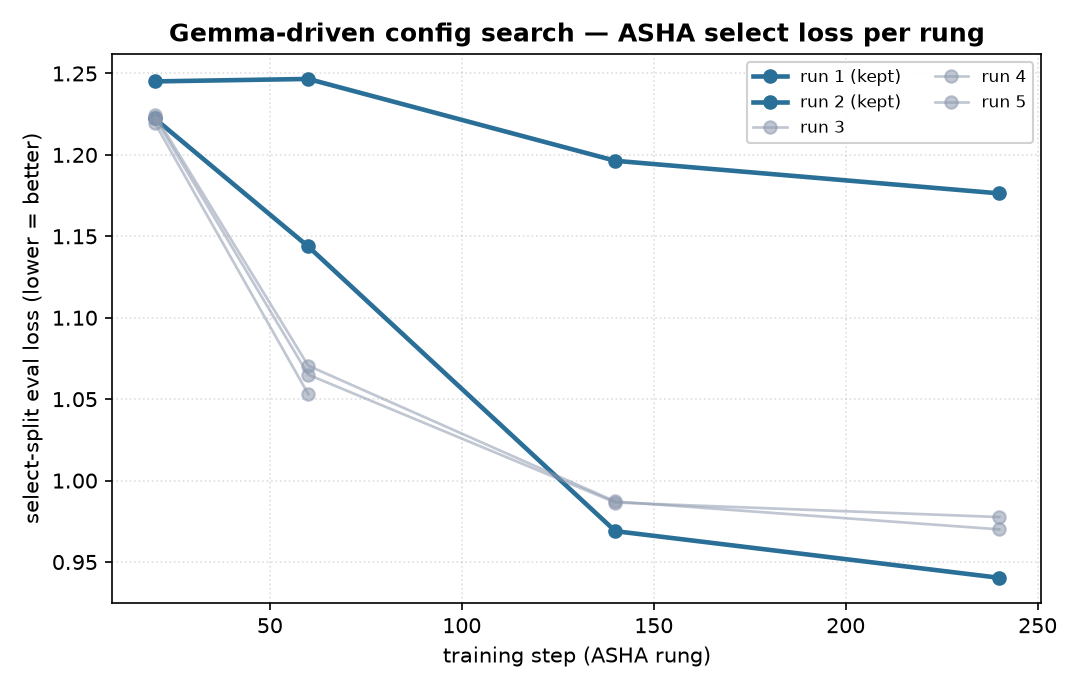
Run 2 (unfrozen LoRA) separates from the pack by rung 140 and holds the lead.
The “can’t cheat” part
Early on, the loop found a “winner” suspiciously fast — a too-small validation subsample let a lucky run look great. The agent wasn’t cheating; it was optimizing the number I gave it.
- 🔒 Sealed test — only its SHA-256 is committed; the worker can’t read the cases
- 📏 Scorer copies the dataset’s grading arithmetic verbatim
- 💸 Worker strips
TINKER_*from env — the free local loop can’t spend a cent - 🧊 Every finalist’s config is committed to git before its one-shot sealed read
Sealed-test results
| Model | Role | Acc ↑ | KL ↓ | Brier ↓ | ECE ↓ |
|---|---|---|---|---|---|
| Prior / Uniform | reference | 0.470 | — | — | — |
| Zero-shot base | no training | 0.483 | — | — | — |
| Tinker 4B | cloud referee | 0.601 | 0.642 | 0.172 | 0.094 |
| LazyDecider 0.8B | the winner | 0.770 | 0.094 | 0.051 | 0.145 |
A 0.8B model, found autonomously, lands KL 0.094 — the metric this benchmark optimizes — for ~$0 on an 18 GB Mac.
Per-domain — strongest on invoices
| Domain | Acc ↑ | KL ↓ | Brier ↓ | ECE ↓ |
|---|---|---|---|---|
| invoice_processing | 0.840 | 0.093 | 0.045 | 0.114 |
| customer_service | 0.796 | 0.115 | 0.059 | 0.162 |
| security_incidents | 0.738 | 0.074 | 0.043 | 0.163 |
| agent_trace_observability | 0.706 | 0.094 | 0.056 | 0.156 |
| Overall (400) | 0.770 | 0.094 | 0.051 | 0.145 |
Best accuracy on invoices (0.840); best-calibrated on security incidents (KL 0.074).
Tinker — the independent referee
A different model (Qwen3.5-4B LoRA), different hardware (cloud),
same sealed test — does the recipe transfer?
A clear lift over zero-shot on the same ruler = the pipeline isn’t fooling itself.
Why open innovation matters here
- 🦥 Agent + model are both open weights → hundreds of reasoning calls a night cost $0
- 🔓 The model is yours → run it offline, push the adapter to HF, fork the recipe
- 🔍 Guardrails are auditable → “can’t cheat” is only credible when anyone can read the sealing logic
A closed API couldn’t give me all three: free overnight reasoning, full ownership, and verifiable integrity.
The lazy payoff
I wake up, open REPORT.md, read what Gemma tried and why,
run one command to retrain the winner — and Tinker confirms it.
I never babysit a sweep again.
Open agent · open model · sealed test · built on a laptop, while asleep.